Definition
Addition and scalar multiplication (Strang, 2016):
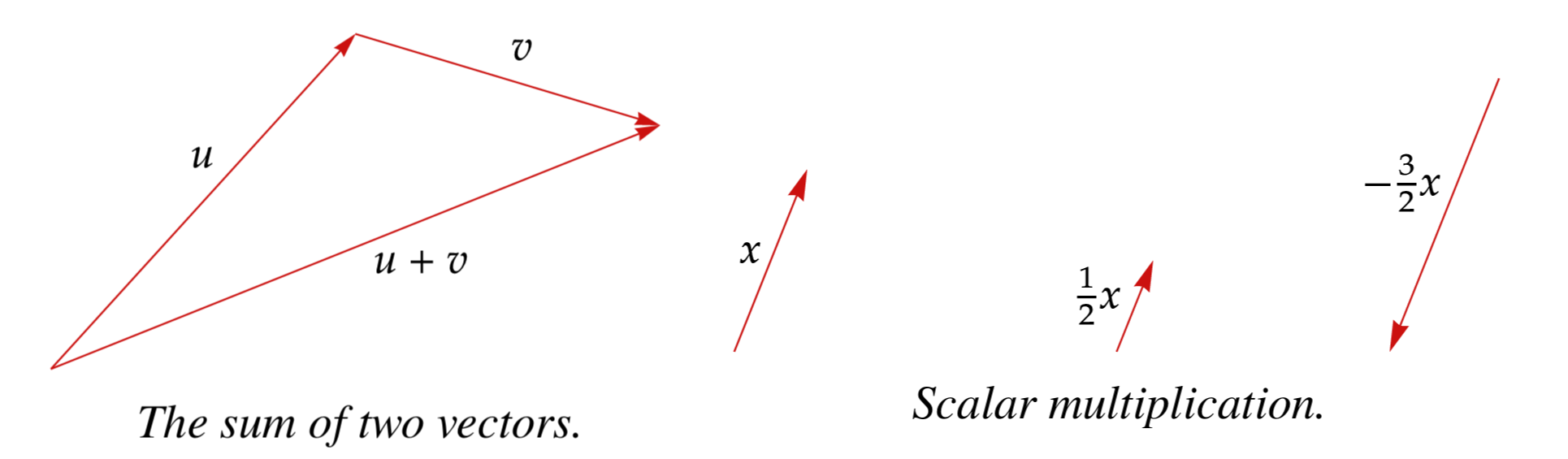
- An addition on a set is a function that assigns an element to each pair of elements .
- A scalar multiplication on a set is a function that assigns an element to each and each .
A vector space is a set with an addition and a scalar multiplication on that statisfy the properties:
Commutativity
Associativity
Additive identity
There exists an element such that
Additive inverse
For every , there exists such that
Multiplicative indentity
Distributive properties
Notice that two distributive laws are different: in the first, on the LHS, is in , in the second in .
Elements of a vector space are called vectors or points.
Direct consequences
0v = 0
- The 0 in the RHS is the number .
- The 0 in the LHS is the vector .
PROOF:
Add both sides with ,
Intuition
The motivation comes from the properties of addition and scalar multiplication in (Axler, 2024):
- Addition: commutative, associative, has an identity, additive inverse, distributive.
- Scalar multiplication: associative, multiplication by 1 acts as expected, distributive.
Since the scalar multiplication in a vector space depends on , to be precise, instead of simply saying that is a vector space, we’ll say
- is a vector space over .
- is a vector space over .
Examples
Example 1: Suppose is the set of real-valued functions on the interval . For and , define and by
and
Thus and .
Example 2: with the usual operations of addition and scalar multiplication is a vector space
- A vector space over is called a real vector space.
- A vector space over is called a complex vector space.
Example 3: The simplest vector space is , which contains only one point.
Properties / Notes
Unique additive identity theorem
A vector space has a unique additive identity.
PROOF (Axler, 2024): Suppose and are both additive identities for some vector space , Then
Thus has only one additive identity.
Unique additive inverse theorem
Every element in a vector space has a unique additive inverse.
PROOF (Axler, 2024): Suppose is a vector space. Let . Suppose and are additive inverses of . Then
Thus .
CONSEQUENCE: Because additive inverses are unique, the notation of are now make sense. Let . Then
- denotes the additive inverse of ;
- is defined to be .
A set can be a vector space over different fields
Some intuitive examples:
R as a R-vector space
This is the real line, its basis consisting of one element, e.g. .
A vector is just a number . Scalar multiplication is just the usual multiplication
- : scalar
C as an R-vector space
This is the complex plane, a basis might be
with dimension
A vector in can be expressed as
- If , we have scalar multiplication
C as an C-vector space
Back to one dimension, a basis might be
Its dimension
A vector in can be expressed as
Finite sets vs finite-dimensional vector space
| sets | vector spaces |
|---|---|
| is a finite set | is a finite-dimensional vector space |
| for subsets of , the union is the smallest subset of containing and | for subspaces of , the sum is the smallest subspace of containing and |
| is a disjoint union | is a direct sum |
| A comparison table from (Axler, 2024) showing the analogy between sets and vector spaces. |
References
https://web.stanford.edu/class/math51h/vectorspaces.pdf